
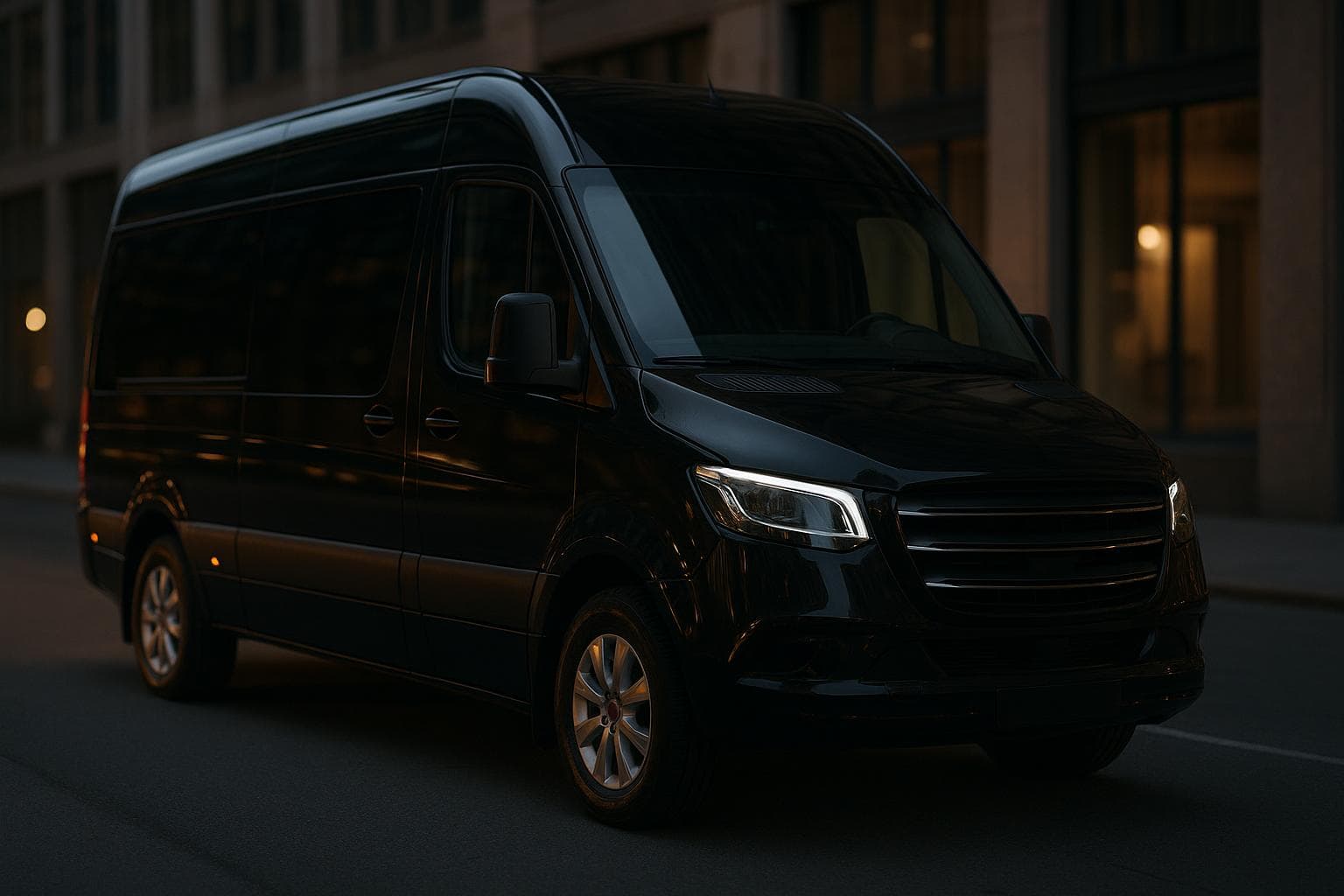
Quick answer: Size the fleet with one calculation: vehicles = guests ÷ seats ÷ trips per window. For 90 guests over 45 minutes with a 13-seat Sprinter doing two loops, that's about 4 vehicles. Add a discreet executive car for VIPs, build in buffer time, and confirm one clear pickup point. Book larger events 4–8 weeks ahead.
Guest transport is the part of an event people only notice when it goes wrong: a queue at the door, a speaker arriving late, a group stranded after the last toast. Get the sizing and staging right and it becomes invisible, which is exactly the goal.
The capacity math
Everything starts from one formula. Take your guest count, divide by the seats per vehicle, then divide by how many round-trips each vehicle can complete inside your arrival (or departure) window:
Vehicles needed = guests ÷ seats per vehicle ÷ trips per window
Worked example, for 90 guests arriving across a 45-minute window:
| Vehicle | Seats | Trips in window | Vehicles needed |
|---|---|---|---|
| Executive Sprinter | 13 | 2 | ~4 |
| Luxury SUV | 6 | 2 | ~8 |
| Mixed (Sprinters + SUVs) | Varies | 2 | 4–6 |
Shorter windows or longer distances between points mean more vehicles, and the trip count is what moves the math.
Continuous loop vs scheduled runs
A continuous loop (vehicles cycling between two points) suits guests who arrive at unpredictable times or a nearby parking lot. Scheduled runs suit fixed groups from set locations, like a partner hotel with a 6:30 departure. Large events often combine the two: scheduled pickups for out-of-town guests, a loop for everyone else.
Staging and flow
- One clear, signed pickup/drop-off point, because the single biggest cause of delay is guests not knowing where to go.
- A short buffer between the last drop and the event start, and again before the final departure.
- A dispatch contact on the ground coordinating vehicles by radio or phone.
- A plan for peak load, since everyone tends to leave within 20 minutes of the end.
Handle VIPs separately
Speakers, sponsors, and leadership shouldn't ride the shuttle. Run a discreet executive chauffeur car alongside the fleet with priority timing, the same principle behind our VIP transportation. For ongoing corporate programs, a corporate transportation account keeps it all on one invoice.
How RAO runs event transport
Give us your guest count, venues, and run times, and we'll size the fleet, build the schedule, and provide vetted chauffeurs and an on-the-ground dispatch, all on one fixed, all-in quote. Request a quote or explore event transportation.
Frequently asked
How many shuttles do I need for my guest count?
Divide guests by vehicle capacity, then by how many round-trips fit your arrival window. Example: 90 guests over a 45-minute window, with a 13-seat Sprinter doing two loops, needs about four vehicles. We'll size it precisely once we know your venue and timings.
Continuous loop or scheduled pickups?
A continuous loop (vehicles running back and forth) suits guests arriving at unpredictable times or a nearby car park. Scheduled pickups suit fixed groups from set locations, like a partner hotel. Many events use both.
How far ahead should I book event transportation?
For larger events, 4–8 weeks lets us reserve the right number of vehicles and chauffeurs, especially in peak season. Smaller runs can be arranged with less notice through our 24/7 dispatch.
Can VIPs or executives have separate cars?
Yes. We routinely run a discreet executive sedan or SUV for speakers, sponsors, and leadership alongside the guest shuttles, with priority timing and a dedicated chauffeur.